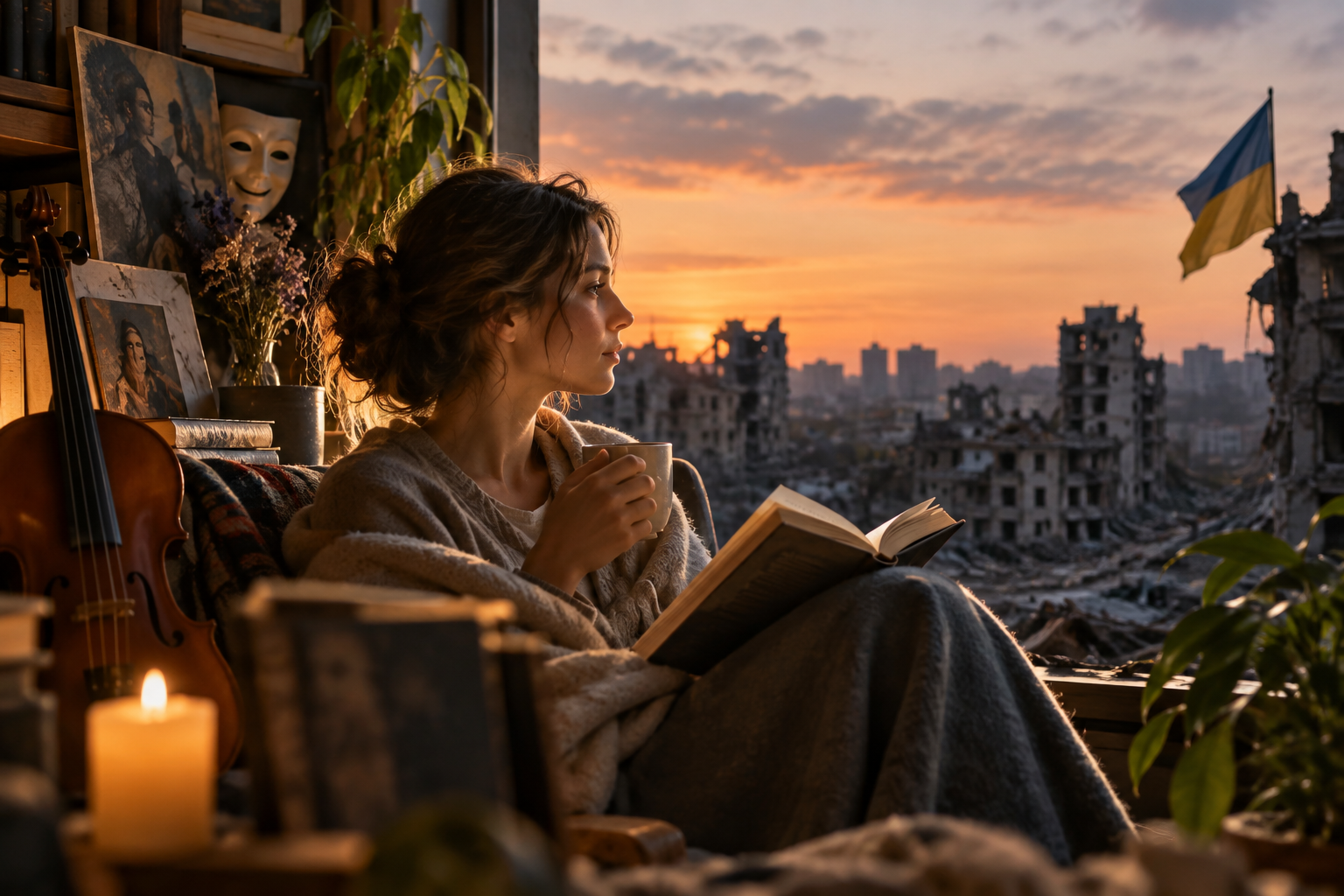
When explosions echo nearby and the news feed is flooded with alarming reports, the urge to go to the theater or pick up a work of fiction often triggers an internal resistance. It feels frivolous, inappropriate — almost immoral, because people are dying somewhere. Yet psychologically, the logic works exactly the opposite way.
Over the years of full-scale war, our psyches have made an extraordinary leap of adaptation. We’ve learned to switch between casualty notifications and work emails, to fall asleep under sirens and wake up to news of shelling. But this adaptability has a dark side: gradually, our inner world shrinks to the bare minimum — cope, survive, don’t break. We continue to function, but we ask ourselves less and less whether we are truly living.
This is precisely where culture stops being an “optional extra” and becomes one of our basic psychological needs.
Art gives us safe access to our own emotions.
Heavy feelings often have no words. And sometimes we consciously deny ourselves the right to feel — afraid that if we start, we won’t be able to stop. Then a line from a book, a melody, a theatrical scene breaks through — and suddenly something resonates inside. We recognize ourselves in another’s story and allow ourselves to grieve, fear, hope — without the risk of facing those feelings alone. Others’ experiences become a safe bridge to our own.
This is also why we seek not only tragedy in culture, but also comedy, music, light cinema. It’s not a contradiction. It’s the psyche’s natural need for balance.
The guilt over “normalcy” is another wartime challenge.
We feel awkward celebrating joy when others are suffering. Laughing when war rages on. But joy and laughter do not equal indifference. They are brief signals to the nervous system: “right now it’s safe — you can exhale.” Without such pauses, we risk exhausting our resources entirely and simply not making it to tomorrow. Rest from war is not escape. It’s a way to preserve enough strength to stay within this reality and not break.
Culture restores our sense of normalcy and belonging.
In peacetime, going to the theater or meeting friends seems ordinary. In wartime, these rituals become nearly sacred: they remind us that life continues, that plans still matter, that we have more control than we think. Moreover, cultural events create a rare experience of shared emotion. When hundreds of strangers in one hall laugh, fall silent, or cry together — there arises a feeling that you are not alone in your pain. Traumatic experience often isolates, even when loved ones are nearby. Culture allows us to share what is too heavy to bear alone.
Finally, culture returns us to ourselves.
War tends to reduce a person to their function: soldier, volunteer, displaced person, mother of a fighter. These are important roles, but none exhausts a personality. We can still love jazz, argue about film, write poems we never show anyone. These are not “trifles” — they are the building blocks of our identity. Culture reminds us: I am not only what the war has made me. I am still myself.
Of course, art does not cure PTSD and cannot replace a therapist when professional help is needed. But it can support, provide respite, help us process emotions, and restore a sense of connection to others. Culture in wartime is not a luxury or an indulgence. It is one of the most accessible ways not just to survive, but to remain alive on the inside.